




In an era of rapid technological disruption, economic restructuring, and growing urban inequality, cities are under increasing pressure to rethink how they compete, innovate, and grow. Innovation districts have emerged as one of the most influential responses to this challenge; but as the model spreads globally, a more difficult question is coming into focus: what actually makes an innovation district succeed?
Too often, districts are still approached primarily as physical development projects, defined by iconic buildings, new infrastructure, or concentrated real estate investment. But the most successful districts are more than just collections of assets; they are complex systems of institutions, governance, talent, knowledge exchange, and long-term coordination.
These tensions sit at the center of Innovation Districts: Designing and Implementing the Transformation of the 21st-Century City, written by Miquel Barceló — urbanist, practitioner, and Strategic Advisor to The Global Institute on Innovation Districts (GIID). Originally published in Spanish in 2023, the recent release of the English-language edition brings Barceló’s thinking to a wider international audience of city leaders, practitioners, and institutions working at the intersection of innovation and urban transformation.
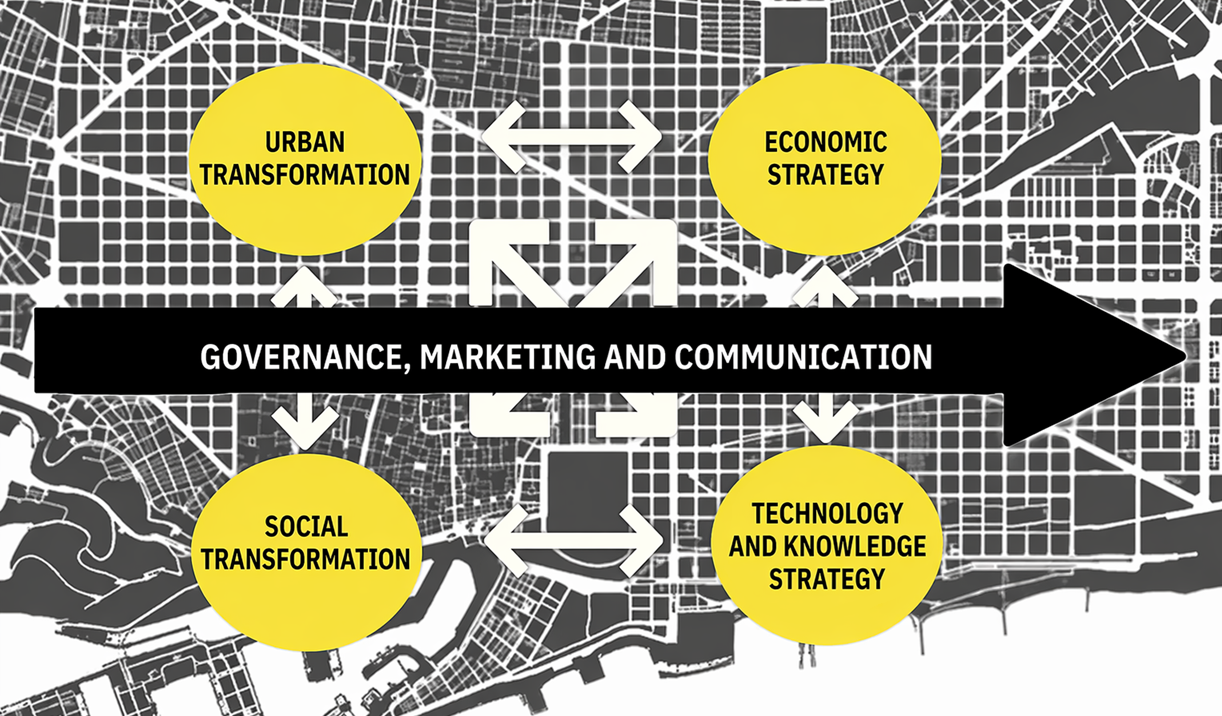
At the heart of the book is a clear argument: innovation districts cannot be understood through physical planning alone. Their success depends on how effectively economic strategy, technology, governance, urban design, and social inclusion are integrated over time. Barceló structures this through a five-subsystem model covering urban transformation, economic strategy, technology and knowledge systems, social transformation, and governance, emphasizing that districts only perform well when these dimensions operate together rather than in isolation.
This systems-based perspective closely aligns with many of the principles GIID has documented through its global research and practitioner networks. Throughout the book, Barceló engages directly with foundational work by Julie Wagner and Bruce Katz in defining the innovation district model and understanding how ecosystem-based urban development functions in practice.
Governance: an underestimated factor
Barceló draws directly on Katz and Wagner’s widely used definition of innovation districts as: “a geographic area where leading-edge anchor institutions and companies cluster with start-ups, business incubators and accelerators. They are also physically compact, transit-accessible and technically wired and offer mixed-use housing, office and retail”.
Similarly, one of the book’s strongest contributions is its emphasis on governance — often the least visible, but most decisive, dimension of district development. Barceló argues that institutional coordination, long-term stewardship, and operational capacity are what ultimately determine whether districts evolve into functioning innovation ecosystems or remain fragmented development projects. This directly echoes findings from GIID’s own research. In Why Governance Matters: An Analysis on How Innovation Districts Organize for Success, Wagner argues that the ability to organize effectively “can be the deciding factor in why one district fails while another succeeds and powerfully evolves,” warning that districts without effective governance risk becoming “stuck in organizational, if not political, gridlock.”
At a time when more cities are adopting the innovation district model while also grappling with questions of resilience, competitiveness, and inclusion, Barceló’s work contributes to a broader shift underway across the field: from thinking about innovation districts as places to understanding them as evolving urban systems.
GIID is proud to count Miquel Barceló among its Strategic Advisors and to support the dissemination of work that advances the field through research, practice, and international exchange.
Innovation Districts: Designing and Implementing the Transformation of the 21st-Century City
by Miquel Barceló is available now in English on Kindle.
Learn more
